

A rollator is an indispensable companion for many people in their daily lives. It provides mobility, safety, and a great deal of independence. But where do you put the rollator when it's not in use? This is where the rollator box (also called a rollator garage) comes in. The box is a practical, secure, and durable solution that protects the rollator from the elements, theft, and damage.
For the box to be truly convenient to use in everyday life, it's not just the quality of the box that matters; its location is at least as important. This guide shows you step by step what you need to consider.
Are you currently looking for a wheelchair or rollator garage? Then please take a look at our website Deutsche Rollatorgaragen . We offer a wide selection of high-quality boxes and garages and provide installation services throughout Germany.

Table of contents
- Why even have a rollator box?
- Step 1: Analyze location, size and space requirements
- Step 2: Substrate and fastening
- Step 3: Weather protection, ventilation & water drainage
- Step 4: Material & Robustness
- Step 5: Single or multiple solution?
- Step 6: Ease of use & accessibility
- Step 7: Safety
- Step 8: Appearance & Design
- Step 9: Additional expert tips
Why even have a rollator box?
🏠 Convenient ground-level parking: No more tedious carrying into apartments or basements.
🌦️ Weather protection: Rain, snow, frost and UV radiation significantly shorten the lifespan of the rollator.
🔑 Theft protection: An unsecured rollator can quickly disappear.
👮Order & Safety: No more tripping hazards in the hallway.
💰 Preservation of value: By protecting against moisture, dirt and damage, the rollator remains fully functional for longer.

|
|

Here are the 9 steps to choosing the perfect rollator box:
Step 1: Analyze location, size and space requirements
The choice of location determines how convenient and safe a rollator storage box will be to use later. A thorough analysis is worthwhile here.
1. Where should the rollator box be placed?
Questions you should clarify:
- Is the box located directly in front of the front door, in the yard, or under a carport?
- How far is the path from the entrance to the box?
- Are there any obstacles such as steps, curbs, or uneven paths?
Important : The entire access to the box should be level, step-free and well-lit.
2. How much space is actually available?
Measure the planned area precisely:
- Width
- depth
- Height
- additional maneuvering space required
3. How big does my rollator box need to be?
Take your time to carefully measure your walker or wheelchair. Making a mistake here can be difficult later on because the chosen box or garage won't fit.
Inexpensive rollators are often not foldable. High-quality models, however, are. For example, the Saljol Allround rollator can be folded from 61 cm wide to just 21 cm with a single movement. Foldable rollators fit into almost any rollator storage box available on the market. Just be sure to double-check the height.

The Saljol Allround Rollator is foldable and therefore easy to store.
Assuming your rollator is not foldable, the most important measurements to take are its width (including wheels), height, and depth or length. Once you have determined these three dimensions, you can confidently select a suitable garage.

Expert tip : The door opening of the rollator storage box should always be wider than the rollator itself – ideally with several centimeters of clearance. Please don't just look at the external dimensions of the box, but specifically search for the door width or height, or even the term "entry dimensions".

Example of the dimensions of a rollato box
4. Building regulations & permits
In condominium associations, rental buildings or publicly accessible areas, the following points should be checked – especially if the rollator box or rollator garage is to be screwed to the floor:
- Is this setup allowed?
- Are escape routes affected?
- Is a permit required?
Rollators are often not allowed to be left in the hallway inside – a box outside is therefore the ideal solution.
Step 2: Substrate and fastening
Check the substrate
A firm, level surface is crucial for stability and safe use. Paving stones, concrete, asphalt, or solidly laid slabs are best suited for this purpose. Lawns, soil, loose gravel, slopes, or generally uneven surfaces are significantly less suitable, as they do not offer reliable stability.
Compensating for differences in elevation
High-quality storage boxes, such as the Anna rollator garage , have height-adjustable leveling screws to compensate for slopes of up to 5 cm. A properly leveled box ensures:
- clean door function
- high stability
- no material stress
Fastening & Theft Protection
Anchoring the unit to the ground with dowels prevents it from shifting due to wind or theft attempts. Please note that screwing it into the ground typically requires approval (for example, from the landlord).
Step 3: Weather protection, ventilation & water drainage
A truly weatherproof rollator box should have the following features:
- completely enclosed construction
- stable, watertight roof
- Ventilation openings at the top and bottom
- Drainage holes in the ground
This prevents condensation, mold growth, and standing water.

Water-repellent material, a sloping roof, and ventilation holes are very important.
Step 4: Material and robustness – an overview of all important materials
Choosing the right material greatly influences the stability, safety, weather resistance, and lifespan of a rollator box. Here are all the relevant options – with their advantages, disadvantages, and practical recommendations.
1. Steel / hot-dip galvanized steel (recommended solution)
Steel remains the most reliable material for everyday use. A high-quality box made of hot-dip galvanized steel is extremely robust and will last for decades without warping or rusting. The galvanizing process permanently protects the metal from corrosion, while an additional powder coating ensures that the surface retains its color and that minor impacts or scratches leave hardly any marks. Steel is a wise choice for those placing the box in a front yard, at a rental property, or in a publicly visible area. While it is heavier and more expensive to manufacture than plastic, you get a solution that won't give way even under heavy use and offers a very high level of burglary protection.
 Garage Paul made of hot-dip galvanized steel in anthracite metallic
2. Aluminum
Aluminum is significantly lighter than steel and has the inherent advantage of not rusting. This simplifies assembly and allows even novices to easily mount a storage box themselves. It is weather-resistant and relatively low-maintenance. However, aluminum has one clear weakness: it is more easily bent and doesn't offer the same resistance to prying tools as steel. Nevertheless, for a sheltered location – such as under a carport or in a private backyard – aluminum can still be a perfectly adequate solution.
3. Stainless steel (V2A / V4A)
Stainless steel is among the most elegant and durable materials for outdoor use. It is completely rustproof, resistant to moisture, UV radiation, and salt in the air – which is why it is particularly popular in coastal regions. Visually, stainless steel has a modern and sophisticated look, which is especially beneficial in demanding architectural designs. The disadvantage lies in the price: stainless steel is significantly more expensive than steel or aluminum. Furthermore, fingerprints are easily visible. However, those willing to bear the higher cost will receive a virtually indestructible rollator box.
4. Aluminum composite panels (Alu-Dibond / ACP)
Alu-Dibond – a composite of two thin aluminum sheets with a plastic core – combines strength with low weight. The material is corrosion-free, dimensionally stable, and available in countless colors, making it particularly appealing to design enthusiasts. It is well-suited for carports or modernly designed entrance areas. However, when it comes to safety, the material doesn't compare to steel. It is more susceptible to damage under heavy loads or vandalism and should therefore not be used in highly exposed areas.
5. Plastic (polypropylene, polycarbonate)
At first glance, plastic boxes seem practical: they are lightweight, relatively inexpensive, and quick to assemble. Polypropylene and polycarbonate, in particular, are weatherproof and require little maintenance. The problem lies in their durability. These boxes offer only limited protection against vandalism or theft, especially if they are freestanding. Over the years, they can fade or become brittle due to UV radiation. Therefore, plastic is more suitable for locations where there is no security risk and the box primarily serves as weather protection.
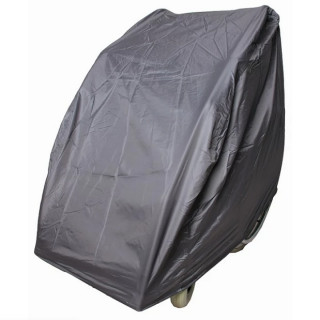 Weather protection, yes, but it's unsafe.
6. Wood (larch, Douglas fir, spruce, oak)
Wood blends particularly harmoniously into gardens or green front yards. Larch and Douglas fir are relatively weather-resistant, while spruce and oak vary depending on treatment. However, the natural look comes at a price: wood requires regular maintenance, needs to be oiled or painted, and is susceptible to moisture, mold, and insects. In terms of burglary protection, wood is significantly less effective than metal. Nevertheless, for purely aesthetic purposes or decoratively designed outdoor areas, it can be an attractive choice, especially when combined with a sturdy metal frame.
 Wooden rollator garage with steel frame
7. WPC (Wood Plastic Composite)
WPC is a material mix of wood fibers and plastic. It combines the warm look of wood with the weather resistance of plastic. This gives it a harmonious appearance without requiring constant maintenance. However, strong sunlight can cause the colors to change, and the material is noticeably less robust than solid metal constructions. For modern garden areas where the box primarily serves as an aesthetically pleasing weather protection structure, WPC fulfills its purpose.
8. Thin sheet metal (ungalvanized)
Rollator boxes made of simple, ungalvanized sheet metal are cheap and lightweight, but perform poorly in practice. The material rusts quickly, is unstable in windy conditions, and can be easily broken open. Thin sheet metal is completely unsuitable for locations permanently exposed to wind, moisture, and potential tampering. Even as a temporary solution, one should carefully consider whether the low price justifies the disadvantages.
9. HPL / Trespa (High Pressure Laminate)
HPL – often known as Trespa – consists of several layers of paper pressed together with resins under enormous pressure. The result is an extremely hard, dense surface that is impervious to UV radiation, rain, and frost. HPL requires no painting or oiling and remains visually stable for decades, which is why the material is frequently used for facades and high-quality garden structures. However, it doesn't offer the same level of burglary protection as metal, as it is hard but not completely rigid. Furthermore, processing it is demanding and should ideally be carried out by professionals. For modern, secure areas, HPL is a durable and very elegant solution – however, steel is generally recommended for publicly accessible locations.
 Rollator box made of HPL
Our recommendation as experts:
Best overall choice: hot-dip galvanized, powder-coated steel – maximum protection and durability.
Good alternatives: HPL, aluminum, stainless steel – depending on the location.
Suitable to a limited extent: wood, WPC, pure plastic solutions.
Step 5: Single or multiple solution?
Individual storage boxes are ideal for private households where only a walker or, if applicable, a wheelchair needs to be protected. They are compact, require little space, and can be placed close to the entrance, making daily access particularly convenient.

Overgrown single rollator box in front of residential building in Berlin
Multiple garages are recommended for:
- Apartment buildings
- Senior living facilities
- nursing homes
- assisted living
- Multigenerational homes
In such areas, multiple walkers, wheelchairs, or mobility scooters often need to be protected simultaneously. Multi-car garages offer a high degree of organization, reduce tripping hazards in the entrance area, and can be shared without each household needing its own garage.

Concept drawing of a multi-story car park in front of an apartment building in Berlin
Note : If you are a private individual interested in purchasing a rollator garage, please speak with your landlord or building owners beforehand. Neighbors may be interested in joining, in which case a shared solution can be installed. We are happy to assist both private and business customers. More information is available here: Business Customers | German Rollator Garages
Step 6: Ease of use & accessibility
A rollator storage box is used daily – therefore, it should not only be safe but also as comfortable to use as possible. Older people, in particular, benefit from well-thought-out details that facilitate access.
- Low or no door threshold: A level entrance prevents the need to lift the rollator. This is particularly important to minimize effort and the risk of falls.
- Gas springs or smooth-running doors: Doors that open and stay open effortlessly are a huge advantage for people with limited mobility.
- Sufficient maneuvering space in front of the box: Plan for at least 50–80 cm of additional space so that the rollator can be easily pushed in forwards and out backwards.
- Easily accessible paths to the garage: The path to the garage should be free of steps, high curbs, and tripping hazards. Uneven paving stones can make access difficult.
- Good lighting of the location: An outdoor lamp or a motion detector increases safety and comfort – especially in the winter months.
Step 7: Safety
A secure location and a good locking mechanism are crucial to reliably protect your rollator from theft and vandalism. We recommend paying attention to the following security criteria:
- Lockable box: Essential for publicly accessible or shared areas.
- Closure types:
- Padlock – a simple, cost-effective solution.
- Cylinder lock – convenient and secure, ideal for everyday use.
- Rod lock – maximum security through locking at the top and bottom.
- Ground anchoring: The box should be able to be securely screwed to the ground. This protects it from wind, shifting, and unauthorized removal.
- Clearly visible location: A rollator storage box should ideally not be placed in dark corners or secluded backyards. A well-lit, visible spot near the front door offers significantly more protection.
A well-lit and easily visible location significantly increases the deterrent effect on potential perpetrators and facilitates everyday use.

A padlock is the minimum, a box with a bar lock is even better.
Step 8: Appearance & Design
A rollator storage box is often clearly visible in the entrance area, so it should blend harmoniously into its surroundings. Modern models offer numerous design and color options that are both functional and aesthetically pleasing.
- Color selection: Classic tones such as anthracite, silver, or white suit most facades. Light colors heat up less in the summer.
- Various roof shapes: shed roof, flat roof or arched roof – depending on what best suits the architecture of the building.
- Design options: wood looks, metal looks, textured surfaces or modern color accents.
- Individual RAL colors: Almost all RAL colors are possible for high-quality metal boxes – ideal for harmonious integration into the living environment.
 Rollator box in unusual purple red
A well-chosen design not only increases the perceived value of the entrance area, but also ensures that the box does not appear as a "foreign object".
Step 9: Additional expert tips
1. Power outlet for electric walkers, electric wheelchairs or scooters
If you use an electric wheelchair or rollator, check the proximity to a power outlet or the availability of an integrated cable entry point. Specialized suppliers can provide excellent advice on this. We believe it's a huge advantage if your mobility scooter, electric wheelchair, or electric rollator can be charged directly in the garage.
2. Long-term care insurance subsidy
Rollator storage boxes can be subsidized as a home improvement measure – in many cases up to €4,000 per household. More information can be found here: Subsidies for home modifications
Conclusion: Finding the best possible rollator box
Choosing the right rollator storage box depends on location, surface, available space, safety requirements, and ease of use. Careful consideration of these criteria will help you find a box that simplifies daily life and provides optimal protection for your rollator.
Are you currently looking for a wheelchair or rollator garage? Then please take a look at our website Deutsche Rollatorgaragen . We offer a wide selection of high-quality boxes and garages and provide installation services throughout Germany.